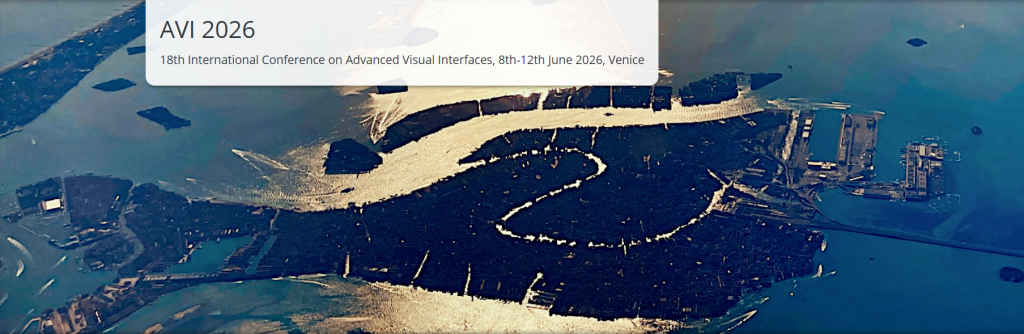
The 18th edition of the International Conference on Advanced Visual Interfaces (AVI 2026) took place in Venice, Italy, from June 8 to 12, jointly organised by Ca’ Foscari University of Venice (e.g., Pittarello, Melonio) and the Free University of Bozen-Bolzano (e.g., de Angeli, Gennari). Under the theme Interactive Creativity: Agencies, Interfaces, and Ethics, this AVI edition marked a significant milestone, in terms of submissions, demand for participation, and the breadth and diversity of its research programme. The conference welcomed a record 237 participants from across the globe. Beyond the numbers, what stood out was the remarkable level of engagement throughout the conference week.
The scientific program showcased the diversity and vitality of contemporary research on advanced interfaces and human-centered interaction. Together, these contributions demonstrated the field’s increasing focus on interaction as a situated, collaborative, and human-centered experience, spanning diverse users and contexts, visual information, urban environments, trust and decision-making, and AI-supported creativity. Beyond the paper sessions, featuring 33 long and 17 short research articles, the 13 workshops (featuring one on a boat navigating the lagoon) and the dedicated session of 23 posters besides 17 demonstrations and interactive experiences created numerous opportunities for discussion, experimentation, and networking. A particularly vibrant highlight was the Doctoral Consortium, which emerged as a lively and engaging forum where doctoral researchers received constructive feedback, exchanged ideas with peers and senior scholars.
A landmark of AVI 2026 was its keynote program, which featured four exceptional speakers whose talks spanned trustworthy AI-supported decision making (Francesco Ricci, Free University of Bozen-Bolzano), vision-driven design from tangible interaction to TeleAbsence (Hiroshi Ishii, MIT Media Lab), multisensory experiences beyond only visual interfaces (Stefania Serafin, Technical University of Denmark), and the societal implications of artificial intelligence and computer science in general (Felienne Hermans, Vrije Universiteit, Amsterdam). Together, these keynotes provided a rich and multifaceted reflection on creativity, ethics, human-centered technologies, and the future of interaction design.
The conference also showcased the increasingly international nature of the AVI community. Authors, reviewers, committee members, and participants came from countries across Europe, the Americas, Asia, and the Middle East, demonstrating the global reach of the conference and its ability to attract contributions from a wide variety of research traditions and cultural contexts. This diversity enriched discussions and strengthened AVI’s role as an international forum for advancing research and practice in advanced interfaces and interactions.
Most importantly perhaps is that AVI continues being remembered not only for its scientific quality and participation, but also for the strong sense of community and “being together” across cultural borders that it fosters. The collaborative spirit of participants created an environment in which ideas could be discussed constructively, new collaborations could emerge leveraging different perspectives, and both senior and early-career researchers felt welcomed and supported.